My Faith Journey
Rev. Seok Nam Lim
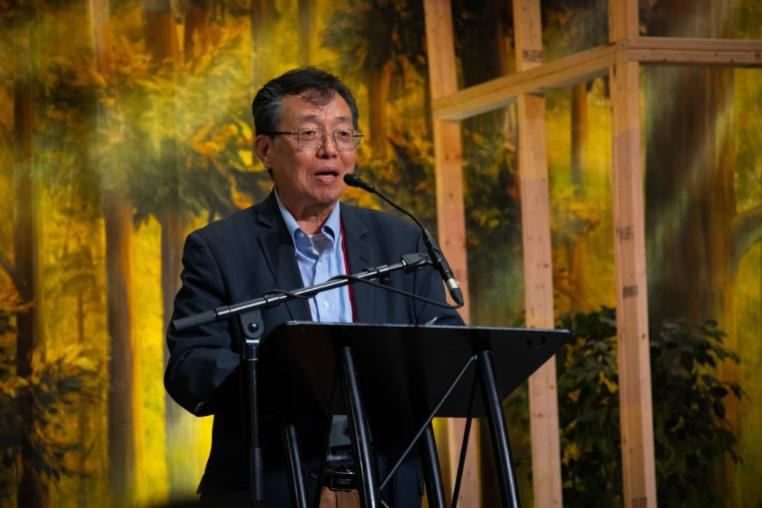
(This picture was taken in the 2025 Michigan Annual Conference of The United Methodist Church: I was invited to present my experience of the ABAR [Anti-Bias & Anti-Racism] program.)
In South Korea, I grew up in the evangelical reformed tradition. After graduating college in February 1984, I went to Hapdong Theological Seminary, one of the well-known schools with reformed theology. But I did not complete my education there. And I worked as a freelance translator. My translations include The Spirit of Christ and The Full Blessing of Pentecost, written by Andrew Murray, the South African pastor with British and Dutch heritage; Joshua in the Light of the New Testament, written by W. Graham Scroggie; and I Am Not Ashamed, written by D. Martyn Lloyd Jones. Except for I Am Not Ashamed, which was published with the name of the translator, Dr. Young-Ho Park, who was the president of the CLC (Christian Literature Crusade) publishing company in South Korea, all the other translations were published with my name, Seok Nam Lim, as a translator.
In June 1988, I immigrated to New York, America. From the first Sunday of 1989, I began attending the First Presbyterian Church of Newtown (PCUSA) in Queens, New York, which was established in 1652, before the independence of America. This church was in the process of being accommodated to the multiethnic neighborhood. The multiethnic and multicultural environment of New York challenged my evangelical reformed tradition. Reflecting on my faith on the streets of New York, I realized that every tradition of Christian faith is conditioned by its own ethnic and cultural contexts. I call this awareness ‘my second regeneration.’ For this reason, I decided to study urban mission at Westminster Theological Seminary, one of the renowned reformed theological schools in Philadelphia, and moved there in 1991.
Ironically, during my studies at Westminster Theological Seminary, I was deeply influenced by the Wesleyan tradition, reading the works of José Míguez Bonino, an Argentine Methodist theologian, and Howard A. Snyder, a former professor of Wesley Studies at Tyndale Seminary and a former professor of the History and Theology of Mission at Asbury Theological Seminary. Most of the theological and ministerial works for social/urban transformation were produced by the Methodist tradition. It raised me to a consciousness of the social gospel, according to which our personal faith should be effective in transforming the world; the gospel of Christ is holistic and transformative.
After graduating from the Westminster Theological Seminary (Master of Art in Religion – Urban Mission Emphasis; 1994), I studied at the New School for Social Research, New York, (M.A. Candidate in Liberal Studies; 1995-1998), Union Presbyterian Seminary, Richmond, Virginia, (M. Div.; 2002), and Columbia Theological Seminary, Atlanta, Georgia (Th. M. in Systematic Theology; 2005). I served as a residential chaplain at Yuma Regional Medical Center in Yuma, Arizona, from 2002 to 2003.
Since I moved to Grand Rapids in August 2008, I began attending The Church of All Nations, The United Methodist Church, and from July to December 2010, during its transitional period, before I became a candidate for the ordained ministry in 2011, I served it as an interim pastor. In 2018, I was ordained in the Annual Conference of Michigan of The United Methodist Church. I was able to sustain myself with the support of the United Methodist Church, primarily according to its vision to make disciples of all nations for the transformation of the world, which corresponds to my faith journey.
My vision is to bring all nations into reconciliation through Christ the Lord and the ministry of discipleship. God’s love never fails, and we are called to put his unfailing love for all in our life contexts. The ministry of reconciliation has been my consistent vision. This vision has been renovated into the threefold vision of The United Methodist Church: “Love Boldly, Serve Joyfully, and Lead Courageously”; we must “passionately love God and unconditionally embrace people of every age, nation, race, and walk of life”; we must “call on congregations to journey alongside vulnerable populations, offering care and compassion with joy”; and we must “encourage followers of Jesus to actively resist and dismantle systems of evil, injustice, and oppression while striving for peace and reconciliation.”